Over the years, I’ve received numerous e-mails and read many forum posts from people saying, “No matter what I do, I can’t get my cooker over 200°F.” Often times, it turns out that they’ve got a bad thermometer and were actually cooking over 275°F!
You should check a new thermometer for accuracy when you buy it and probably once a year thereafter, or any time it is has been dropped or subjected to abuse.
Here are two methods to test a thermometer for accuracy, followed by tips on what to do if your thermometer is not accurate.
Ice Bath Test
The ice bath test is the easiest way to test a thermometer for accuracy, assuming your thermometer will display temperatures of 32°F or less. The advantage of this method is that an accurate thermometer will always read 32°F in a properly made ice bath regardless of elevation or atmospheric pressure.
To make an ice bath, you will need:
- A tall glass
- Pre-chilled water
- Ice cubes
- Something to stir the ice and water
In my experience, ice cubes from the refrigerator ice maker seem to work better than crushed ice.
Fill a tall glass to the top with ice cubes. Add pre-chilled water to just below the top of the ice. Stir for about 15 seconds.
Insert the thermometer stem or probe 2″ into the center of the ice bath and stir gently for another 15 seconds, keeping the stem surrounded by the ice cubes and moving constantly.
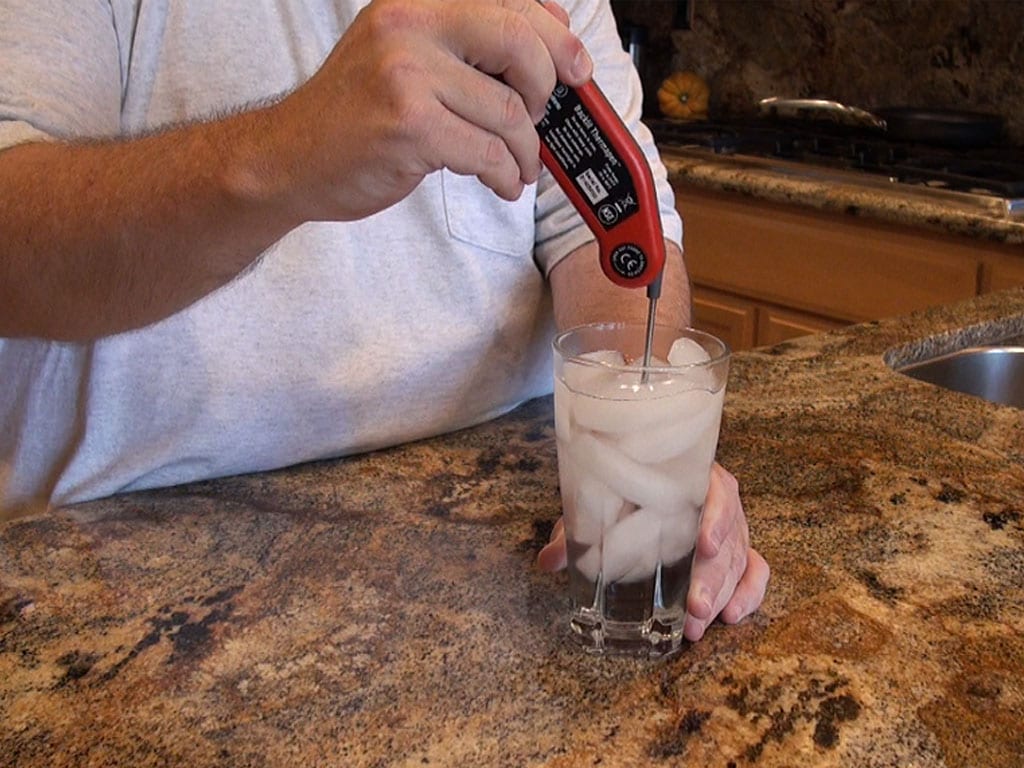
An accurate thermometer will read 32°F. Don’t let the thermometer rest against the ice or you’ll get a low reading. Don’t let the thermometer rest against the glass or you’ll get a high reading. Don’t measure the temperature of the clear water below the ice, as it may not be 32°F.
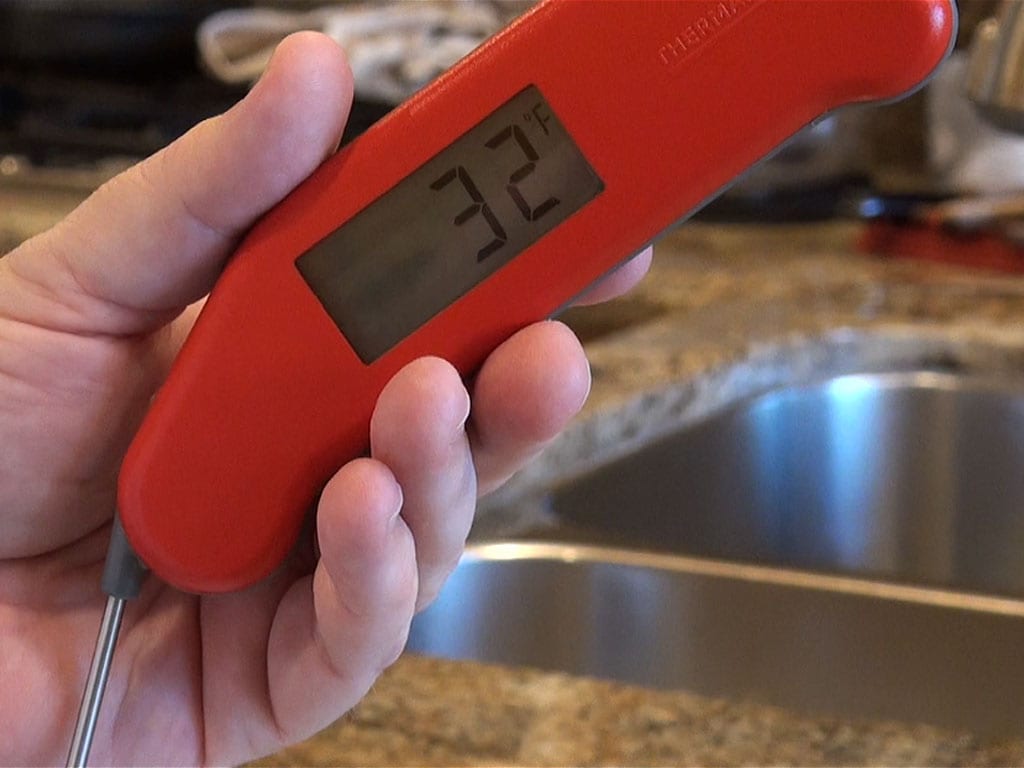
This video demonstrates the process of making a proper ice bath.
Boiling Water Test
The boiling water test is a more complicated way to test a thermometer for accuracy because you must take elevation and atmospheric pressure into account when calculating the boiling point for your location. An accurate thermometer will read 212°F in boiling water at sea level under normal atmospheric conditions, but you probably don’t live at sea level and your atmospheric pressure varies constantly from day to day.
The first step is to determine the boiling point for your location using this Boiling Point Calculator.
With the boiling point determined, bring 4″ of water to a vigorous boil in a short, wide pot. Insert the thermometer stem or probe 2″ into the boiling water, stirring gently for about 10 seconds, then take a reading.
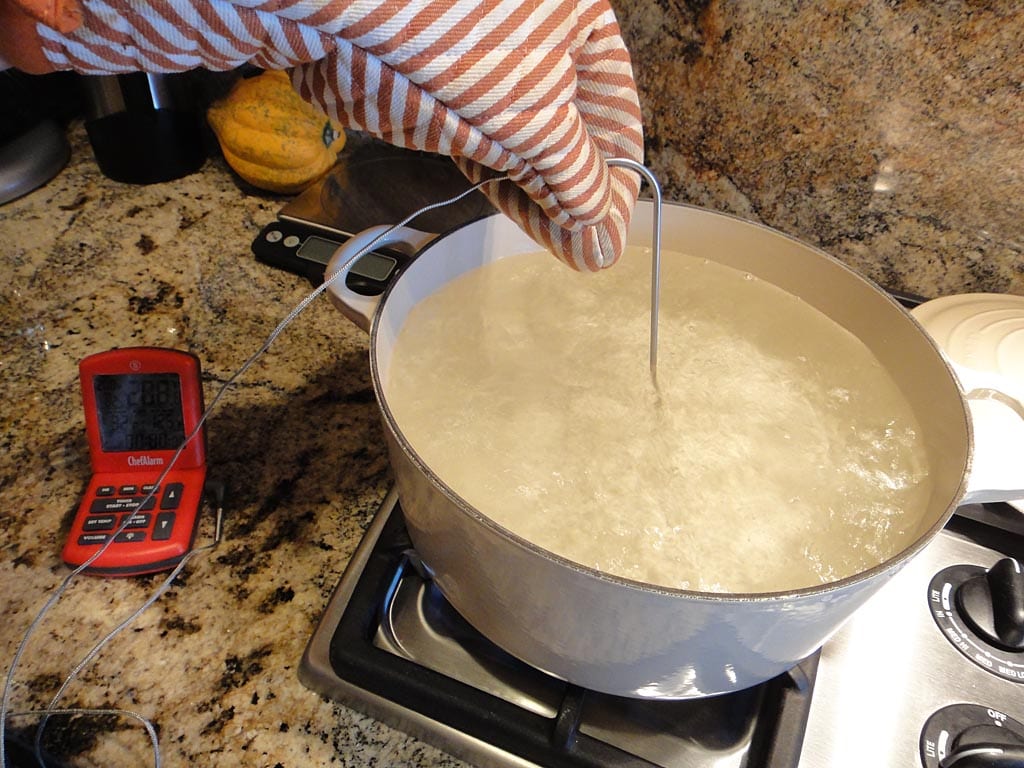
A high-quality instant-read thermometer like the ThermoWorks Thermapen ONE should read within +/-0.5°F of the boiling point for your location. A high-quality bimetal thermometer like the Tel-Tru BQ300 BBQ Thermometer should read within +/-2°F of the boiling point.
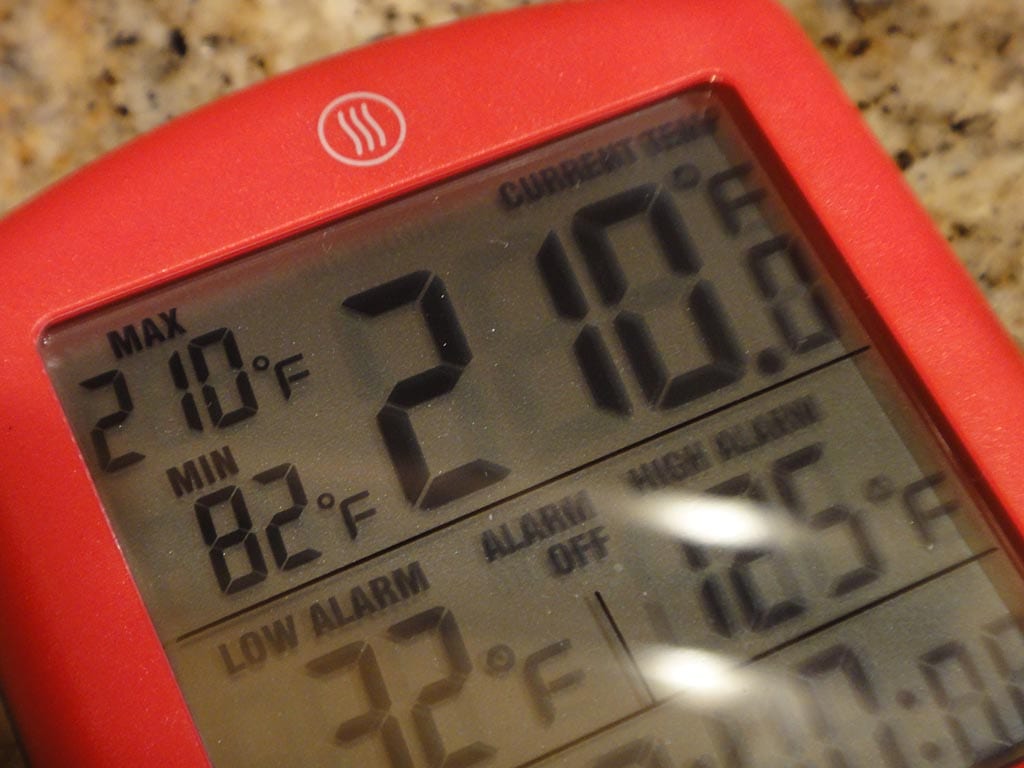
The ThermoWorks ChefAlarm shown in these photos registered 210°F in the boiling water test. At the time of these photos, the boiling point for my location was calculated as 210.5°F. The ChefAlarm was off by just -0.5°F, making it a very accurate probe thermometer.
Remember that there are other factors that affect the boiling point of water:
- Hard water boils at a temperature 1-2°F higher than soft water, due to dissolved mineral salts.
- Using a tall, narrow pot will result in a boiling point about 1°F higher than a short, wide pot.
What To Do If Your Thermometer Is Inaccurate
When testing a thermometer for accuracy, all you’re trying to do is make sure that your unit is not grossly out of whack. You should be worried about being off by +/-20°F, not +/-2°F. If your testing shows that your thermometer is off by only a few degrees, don’t do anything—just take those few degrees into account when reading your thermometer.
It should be noted that even high-quality, industrial-grade thermometers are only accurate to +/-1% of their scale. This means that at a standard 212°F boiling point, these thermometers may read as much as 2°F above or below the actual temperature and still be within manufacturing specifications.
Bottom line: Don’t sweat your thermometer being off by a few degrees!
If your thermometer is off by +/-5°F or more, you may want to consider replacing it with a higher quality model. See Measuring Temperature In The Weber Bullet to learn more about available options.
Inexpensive thermometers typically cannot be recalibrated if found to be inaccurate, but more expensive units may be recalibrated by the manufacturer and in some cases by the user. Consult the instructions that came with your thermometer for details.
More Thermometer & Temperature Links On TVWB
- Installing A Thermometer
- More Thermometer Installations
- Cutting A Probe Thermometer Slot
- Measuring Temperature In The Weber Bullet
- Temperature Control Problems: Too Hot, Too Cool
- Cooking In The Wind, Rain & Cold
- Vent Damper Modifications
- WSM Temperature Tests
- Boiling Point Calculator
- WSM Modifications Forum on The Virtual Weber Bulletin Board